
Details of WebSocket and JSON-Based Communication
Why Traditional HTTP is Not Enough
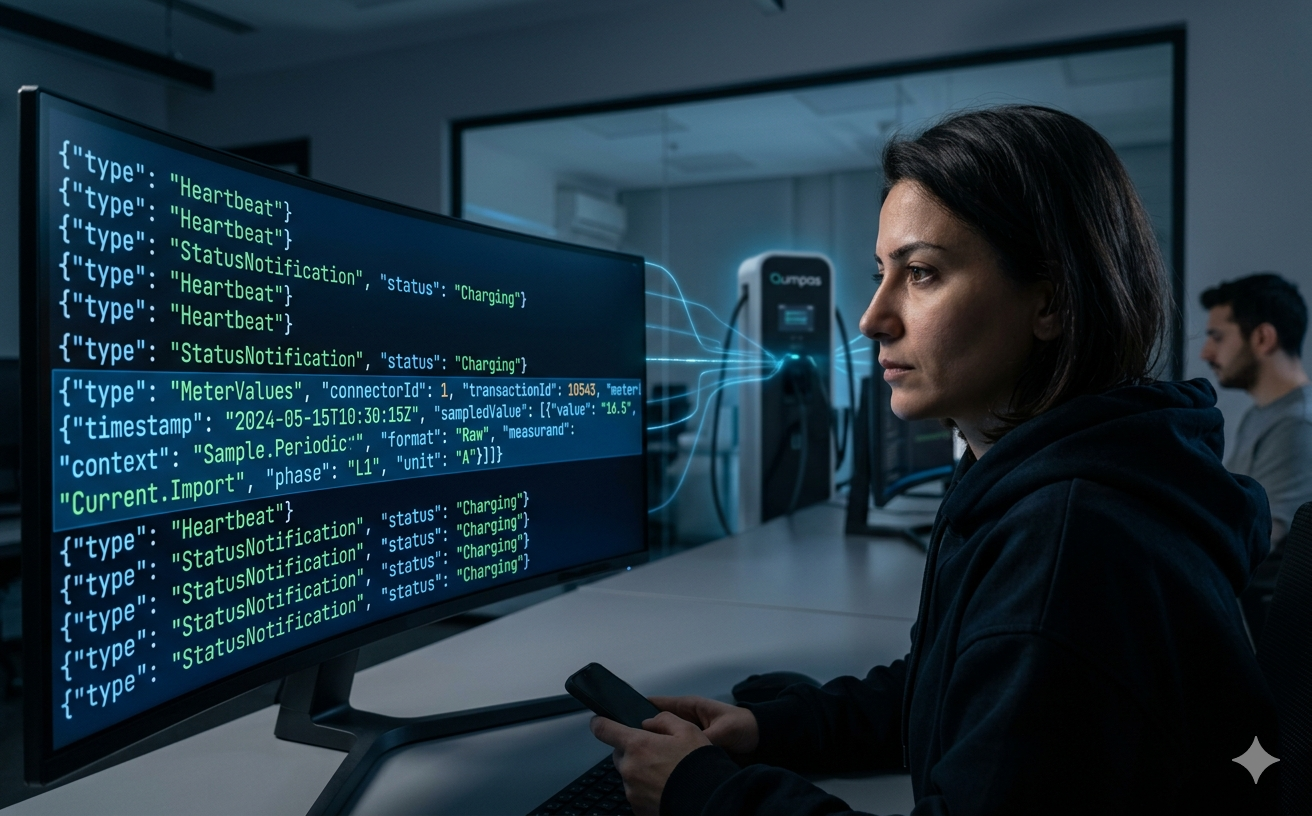
The "request-response" model used in traditional web architectures is too cumbersome for systems requiring real-time data tracking, such as EV charging networks. For a charging station to report an emergency stop or an instantaneous current change, waiting for a request from the server means losing critical seconds. To solve this, Qumpas utilizes WebSocket technology to establish an "always-on" digital tunnel between the station and the central server.
1. WebSocket: Bidirectional and Real-Time Communication
The WebSocket protocol provides a full-duplex communication channel over TCP. The technical advantages of this architecture include:
-
Low Overhead: Unlike HTTP, which repeats header information with every request, WebSocket eliminates this redundancy. Once the connection is established, only pure data flows through.
-
Instant Push Notifications: If a sensor error or voltage fluctuation occurs at the station, a "Push" message is sent to the server immediately. This allows the Qumpas panel to trigger alerts within seconds.
-
Persistent Connection (Keep-Alive): Whether a station is online is monitored with millisecond precision using "Heartbeat" signals.
2. JSON: The Universal and Lightweight Language of Data Exchange
Data carried within the OCPP protocol is packaged in JSON (JavaScript Object Notation) format, which offers high readability and ease of processing:
-
Parsing Speed: JSON is parsed by the CPU much faster than older formats like XML. This minimizes the processor load on the hardware.
-
Readability: It is easy for technical teams to diagnose errors by examining logs. For instance, a BootNotification or MeterValues message is as transparent as a standard text file.
-
Flexibility: Adding next-generation charging features (V2G data, complex error codes) to the data structure is highly straightforward thanks to JSON’s flexible key-value structure.
3. Security Layer: WSS and Encryption
Unlike standard web traffic, WebSocket traffic flows over WSS (WebSocket Secure), a stricter security protocol. Qumpas prevents data manipulation and "man-in-the-middle" attacks by utilizing TLS 1.2/1.3 encryption layers. Sensitive authentication keys within JSON packets are secured through this encrypted tunnel.
Seamless Operation Through Software Power
Qumpas’s WebSocket and JSON-based communication infrastructure enables a hardware-independent ecosystem. Regardless of the charging unit brand you use, our software transforms your device into a "smart node" using this universal language. Built on speed, security, and scalability, this architecture ensures your network is ready for the high-volume traffic of the future.